
Art crimes
What the heck?

I want to make a living as an artist. In the mean time, I have a day job as a professor of criminology and criminal justice. Over the last few years, my art job has started to leak into my university job. For example, this semester I’m teaching a seven week unit on art crimes (ie., theft, forgery, and fraud). While preparing for the class, I sat down to look over some crime rates. I like crime rates. They put things in perspective and make pretty graphs.
For example, check out this one about art thefts1:
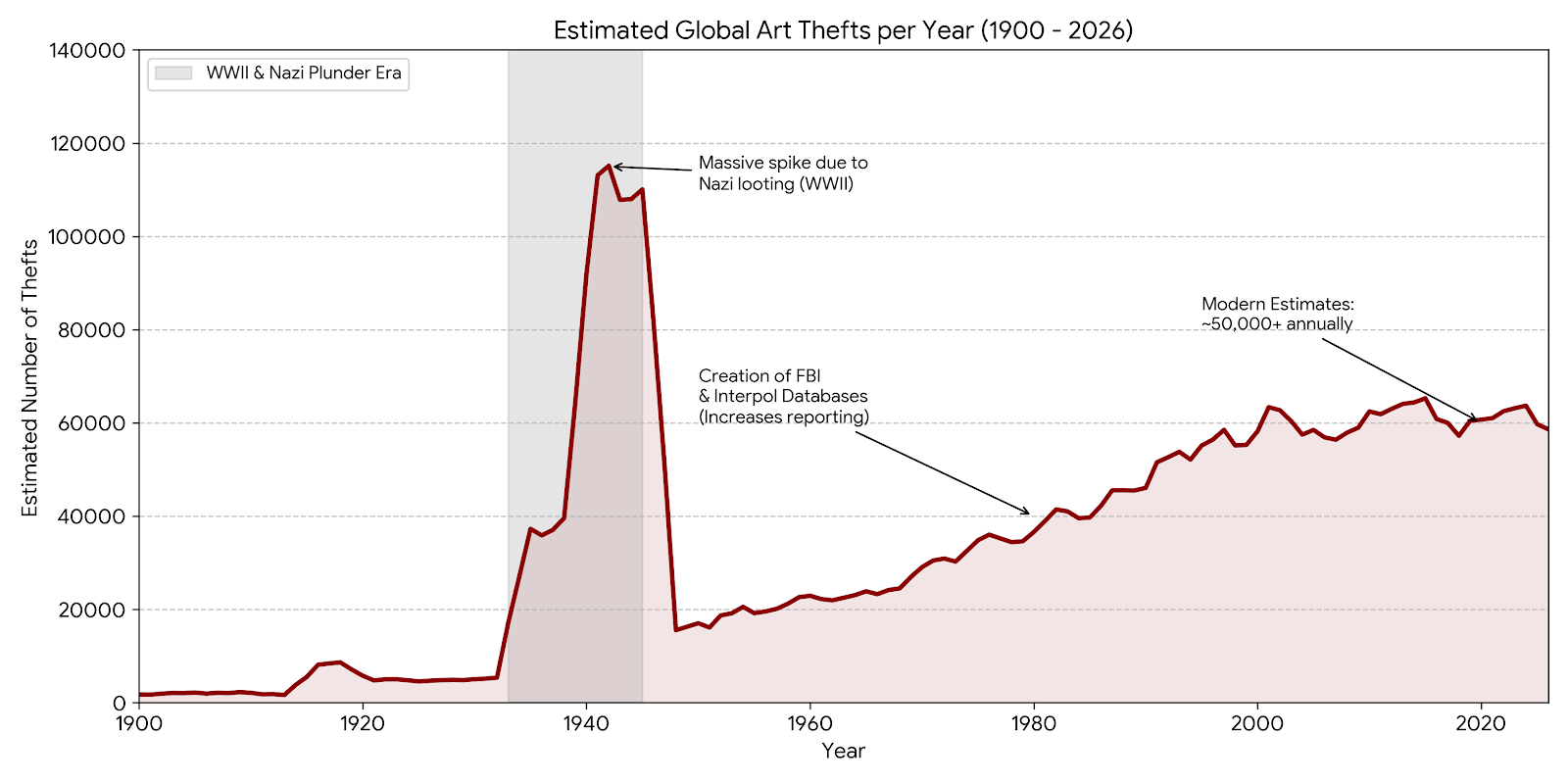
What the heck2?
Here are two more; the volume differs but the pattern, for all intents and purposes, is the same across all three categories.
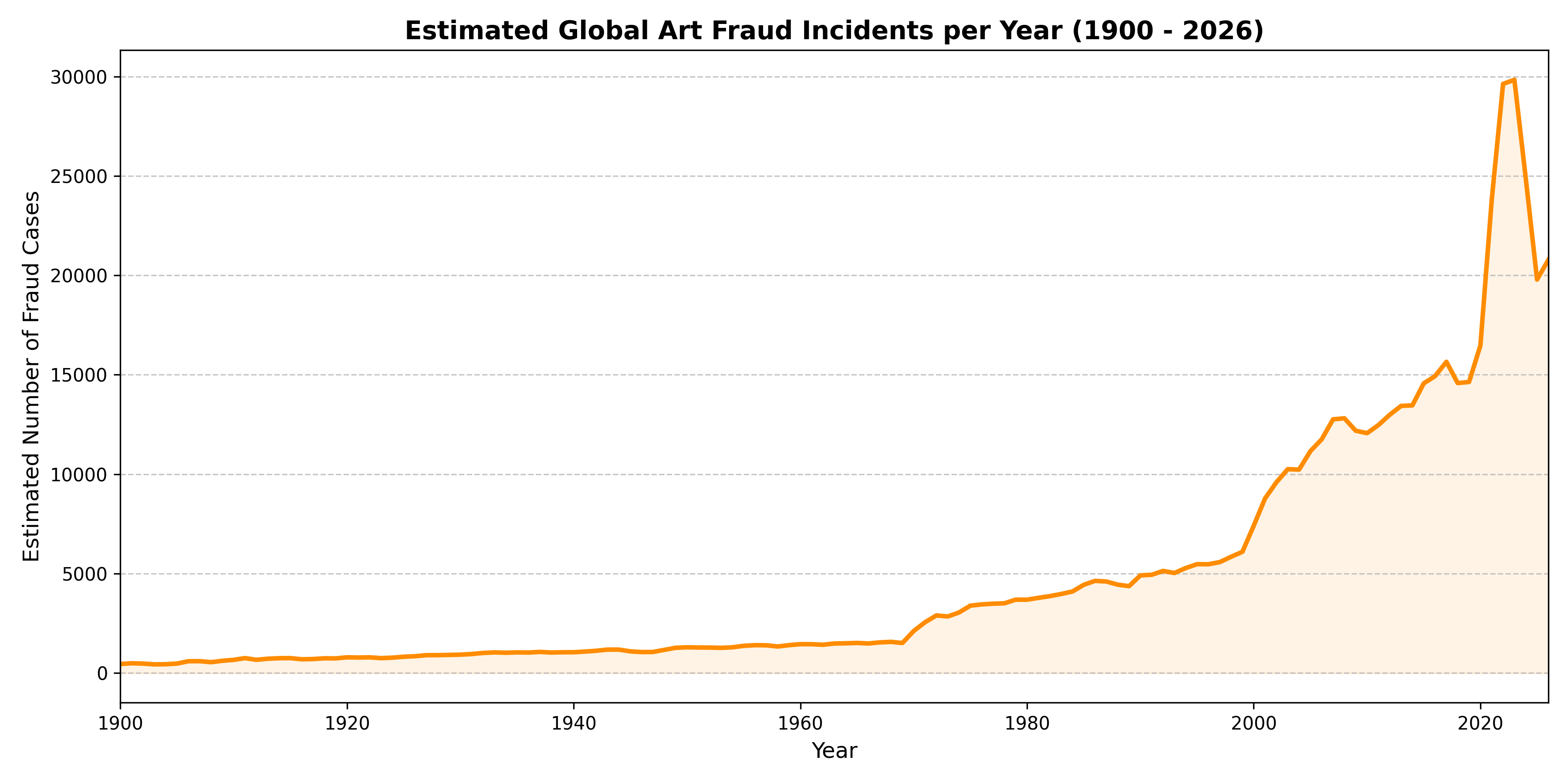
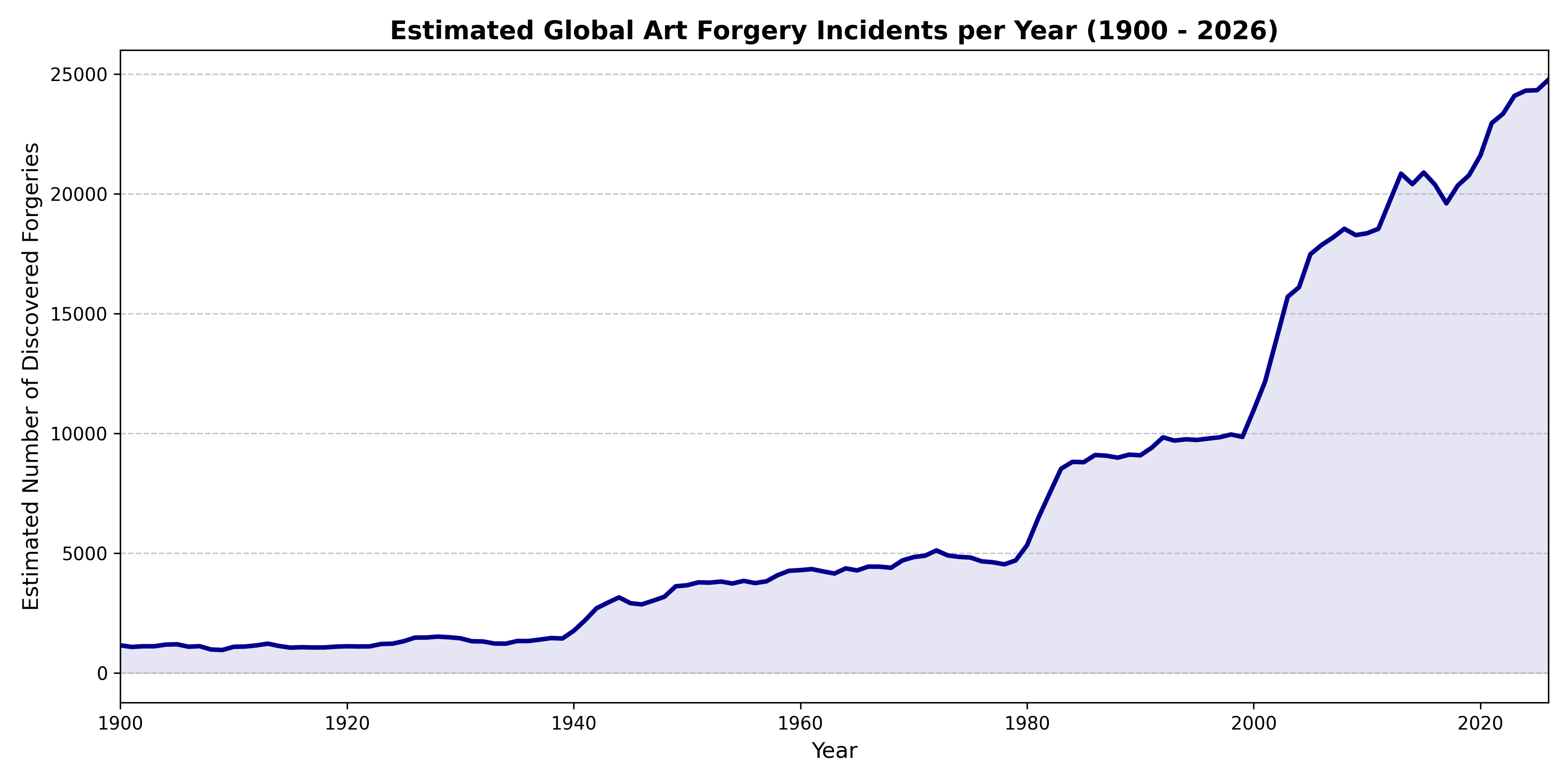
Again: what the heck?
Here’s why I keep saying “what the heck”. Below is a line graph of crime in the United States since 1930. It comes from the FBI’s Uniform Crime Reporting program and counts the number of criminal homicides (murder and nonnegligent manslaughter), forcible rapes, robberies, aggravated assaults (violent crimes), burglary (breaking or entering), larceny-theft, motor vehicle theft, and arson (property crimes)3. Let’s also superimpose the American art crime rate4 onto the graph5.
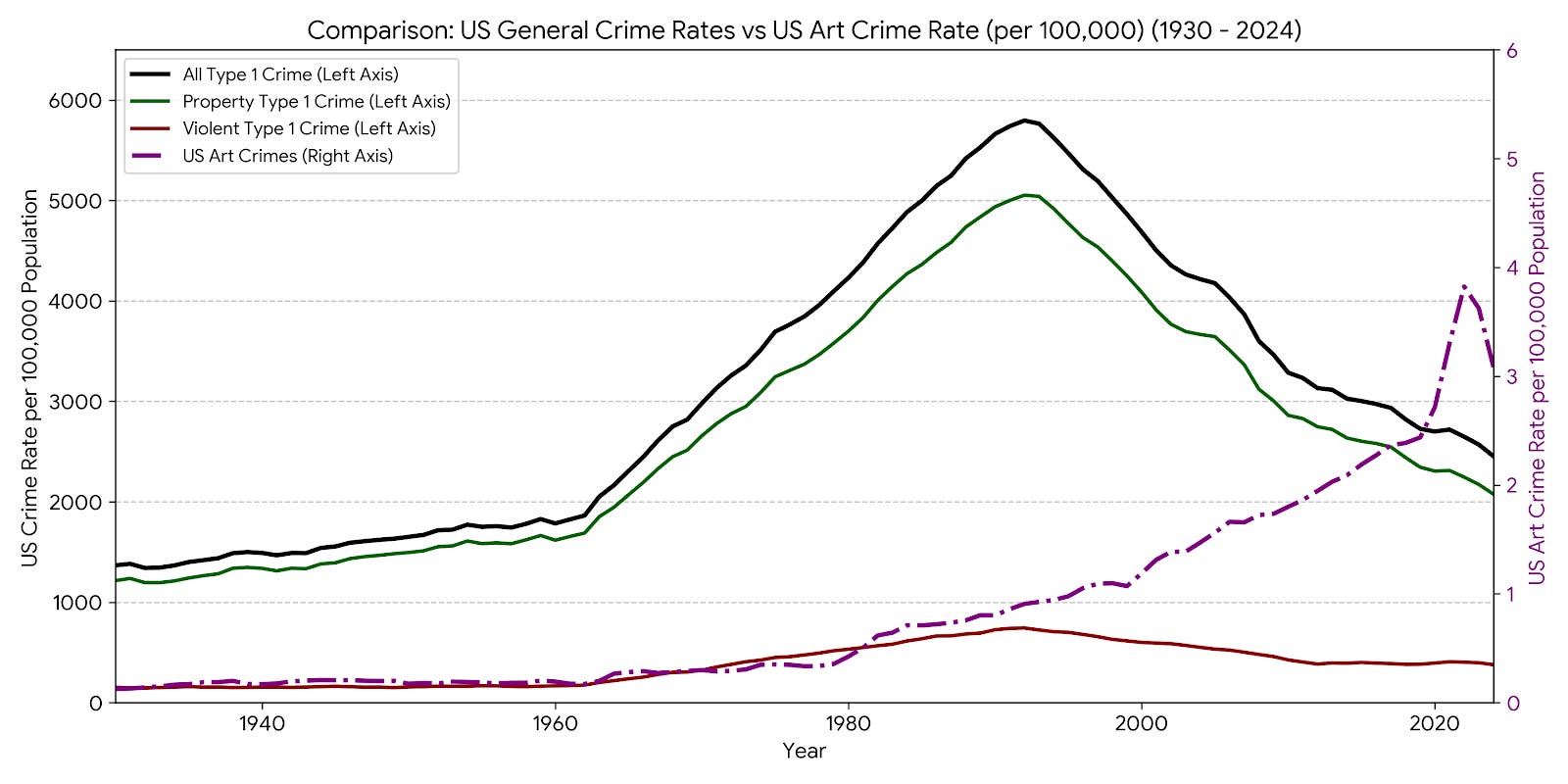
Wait, what? You see, crime rates plummeted starting around 1994. This decline was across the board (and effectively around the world), which is to say both violent and property crimes experienced the same phenomenon.
But not art crimes. Art crimes don’t care. They went along with crime more generally until the art crime rate took a sharp turn upwards, and kept going up.
What the heck? What makes art crime so special?
Preface: I don’t know. I only have some ideas.
First, there’s a pretty solid connection between the ossification of America as a world financial center, its relation to the global art market, and the increase in art crime6. This is itself a unique pattern. Crime generally decreases during times of economic certainty. This may, may, suggest that I’m comparing apples to oranges.
Second, the incredible increase we see in the 21st century - especially the last 5 years or so, is almost certainly directly related to online wire fraud targeting US galleries; e-commerce forgery networks; and the ridiculousness of the NFT year.
So the picture could kinda maybe look like this: the financialization of the art market in the 1980’s had an enormous impact on art crime, increasing both forgeries and fraud7. Organized crime began using fine art to launder money and evade taxes, and forgers took advantage of the opaqueness of the art market. Forgers and fraudsters went nuts in the 21st century again because of the Internet. They have fallen in love with online auction sites, flooding the market with cheap fakes, false prints, and “misattributed” antiquities. If the Swiss Fine Art Expert Institute is to be believed, up to 50 percent of the current art market could consist of forgeries8.
I’ve studied crime for twenty years, and I’m still not for sure about its etiology, be it at the individual or at the societal level. I’m pretty for sure about a handful of associations, but the big “why” question has yet to be answered to my satisfaction as a social scientist. And after looking at art crime, this stance has become all out existential madness9.
Stay tuned! Next week I dive into what sorts of art objects are missing and (kinda) why!10
Please note: As a Blick’s Affiliate and an Amazon Associate I earn from qualifying purchases.

So, let me make sure I’m putting all my cards on the table, here. I made use of Gemini to create these line graphs, and that required making up a bunch of these data. Or, to use statistical terms, it interpolated pretty much anything before the FBI started keeping records in 1979 (excepting the WWII period). This was a very subjective process. In addition to data from the FBI’s National Stolen Art File, Gemini took into account data from Interpol’s Stolen Works of Art Database. This began in earnest in 1995, but it picked up from Interpol’s initial efforts at tracking stolen art work that started in 1947. Art fraud was even trickier. Not only does the trend include accounts of mid-century master forgers (eg., Han van Meegeren) but also the financialization of the art market in the 1980s, and the well-documented explosion of fakes facilitated by online auctions (read: eBay) in the early 2000s. Reports and estimates from the Fine Art Expert Institute were also considered. Art fraud was a little easier. I guess. These estimates took into account the shift of art becoming a major asset class used for money laundering; and the huge spike in the 2020s from blockchain analysis firms and their documentation of fraud, wash trading, and “rug pulls” during the 2021–2022 NFT and digital art frenzy.
So, what does this mean for the charts? Think of them like a TV show or movie that begins with the words, “based on a true story”, up until about 1980. And even after 1980, keep in mind that art crimes - like many crimes - go woefully underreported, either due to a lack of reporting practices or a lack of realization that one has purchased a forgery.
The Nazi looting and subsequent illicit sales is relatively accurate and does not require explanation.
The UCR is actually measuring arrest rates, but it’s a reliable dataset and one that is conventionally used to measure the crime rate. It generally underestimates crime, but the pattern is accurate. We know this because it agrees with other American-wide surveys of crime, such as the National Crime Victimization Survey (NCVS) - at least, in pattern, if not in volume. Despite the methodological limitations (of which there are many; cf the FBI’s website on the UCR), the UCR works as a reasonable proxy for criminal activity. Or at least a reasonably ok proxy.
Yes, art crime - at least theft - is also captured in the crime rate, but I don’t feel like parsing that out. And in any case keeping them together supports the strange paradox I’m exploring here because if art theft contributes to the overall crime rate, yet art crime (including theft) is itself going up, there is something mysterious afoot here. Granted, there’s likely considerable measurement error in the UCR for art theft, but there’s probably also considerable measurement error in all art crime measurements. Such is the burden of social statistics: they suck.
For all intents and purposes, the global crime rates and art crime rates follow these patterns, even if the volume differs. This is a generalization with plenty of exceptions (for example, check out Taiwan’s longitudinal crime rate; it does follow the same pattern, but it’s a few years “behind”), but it’s a fair generalization.
As I am proofreading this, it occurs to me that art crime is so tied to the market that my MBA brother with a background in economics is probably better situated to speculate on this matter than I ever will be. Nevertheless, I shall persist. I’m not even for sure what I mean by “the market”.
All forgeries are frauds but not all frauds are forgeries. (Like all fingers and thumbs but not all thumbs are fingers. Now what are toes? #zach) And forgeries are unique enough from other forms of fraud they're worth exploring on their own (in my humble and correct opinion).
I’m not even for sure what to say about AI at this point, but I’m sure it, too, is being exploited for art crimes.
Ph’nglui mglw’nafh Cthulhu R’lyeh wgah’nagl fhtagn!
I was incredibly lazy about my sources while writing this. Mae culpa. What follows is a list of sources that I may or may not have consulted now or in the past. I also made ample use of Gemini to create the line charts and interpolations.
The FBI’s Uniform Crime Reports and National Stolen Art File, along with reports from Interpol and Fine Art Expert Institute.
The Census Bureau’s National Crime Victimization Survey.
Priceless: How I Went Undercover to Rescue the World’s Stolen Treasures by Robert K. Wittman
The Art Thief: A True Story of Love, Crime, and a Dangerous Obsession by Michael Finkel.
The Forger’s Spell: A True Story of Vermeer, Nazis, and the Greatest Art Hoax of the Twentieth Century by Edward Dolnick.
This Is a Robbery: The World’s Biggest Art Heist. (Docuseries)
Made You Look: A True Story About Fake Art. (Documentary)
The Lost Leonardo. (Documentary)
inter alia
I haven't read one of your post in a while. More of a reflection of me not you. Not sure why I read this one except I felt drawn too. Your writing as always very impressive. I especially loved your citations. ❤️.
This is very interesting. I have wanted to understand how fine art has been used in money laundering.